What’s the Article Talking About? The article explains how driver training programmes help businesses save money by improving driving habits. It also sheds light on reduced fuel use, fewer accidents, and better overall efficiency.
The companies that provide their employees with the pick-up and drop-off facility need to be vigilant in keeping tabs on many factors, including fuel bills, the driver's profile and health, and other maintenance costs. Today, we are talking about how such factors that incur overbearing costs to a company can be reduced or cut off by a margin.
The fleet costs are broken into three parts: fixed, operating, and indirect. The operating costs are the actual pocket-pinchers. In Australia, on average, total operating cost per vehicle per mile is approximately $1.17, which is roughly $0.73 per km. Although this amount might look small, when things add up to the totals at the end of the month, it goes way higher than you think.
This is where our talk of the day comes into the picture. Driver training programmes like low-risk driving courses, corporate driver training, and defensive driver training are the smartest way that can bail you out of this money trap. By improving driving habits, businesses can cut down on major expenses without compromising efficiency. Let’s talk about the advantages of such training and how they will help you in your business operations.
Benefits of Corporate Driver Training
When a driver is trained in the right way, there will be no chance that they might have to incur the extra costs that you might’ve been paying so far. Not just this, with the right training session, your driver will feel confident to handle any kind of discrepancy if it occurs. Small changes in the driver's behaviour can lead to big savings across areas.
Reduced Fuel Consumption
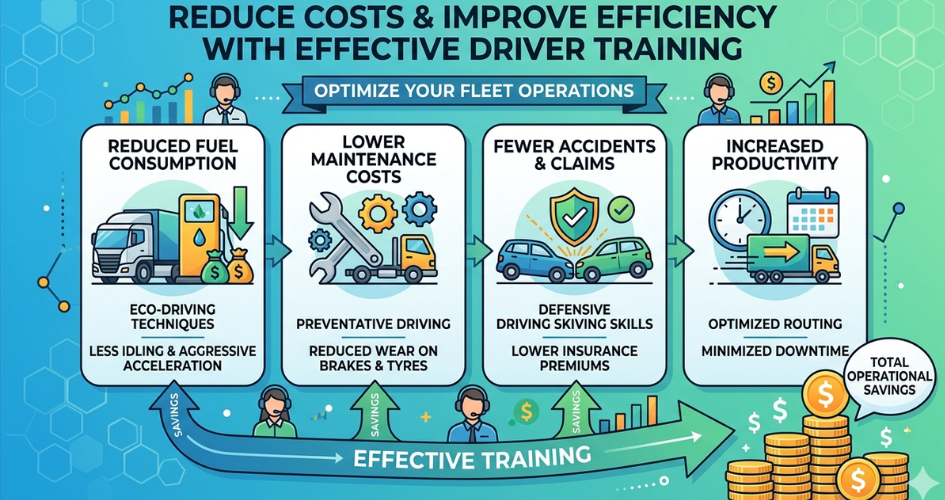
This is one of the most expensive variable costs that strains the budget. A lot of factors, including route or travel, inconsistent speed, and sudden acceleration or braking, contribute to burning more fuel than necessary. A low-risk driving course is designed to teach drivers how to maintain constant control on the road while driving. Simple habits can reduce fuel consumption by a margin of 15%, which will save a lot when you multiply that across an entire fleet.
Lower Maintenance Costs
Rough or erratic driving not only wastes fuel but also damages vehicles over time. It wears out brake pads faster; aggressive turning affects tyres, and consistent strain impacts the engines. The low-risk driving course helps to mitigate such problems. How? Drivers are trained in such a manner that they can handle vehicles carefully. This reduces maintenance costs and keeps the fleet running efficiently for longer.
Fewer Accidents
One accident can cost more than a life. Not only is it a bizarre situation for a driver or anyone involved in it, but the company also loses confidence among the public and its own employees. Repair costs, insurance claims, and service interruptions affect business performance negatively. But with the help of defensive driving training, drivers are trained in a way that they can anticipate risks and make a decision accordingly. This not only reduces accidental risks but also helps in maintaining business capital in a good way.
Enhanced Employee Productivity
Driving, for sure, is a stressful task, especially in a high-pressure environment. To reduce such stress and allow the driver to drive safely and soundly, corporate driver training helps in this a lot. Post-training, drivers tend to become more confident and are more focused on the road. In all this, it isn’t just the driver who experiences wellness in his work, but even the company profits with improved productivity, hardly any delays, and fewer incidental claims.
ROI of Driver Training Programmes
Before enrolling or thinking of doing so, it is comprehensible that companies might hesitate to orchestrate any training in such matters. But the return on investment (ROI) on the corporate driver training services is not just monetary but psychological, too. Even a modest 10% improvement in fuel consumption can lead to a handful of savings. Add maintenance costs, insurance, and fewer accidental damages. When viewed from a broader perspective, you won’t be just investing in a mere curriculum but something that saves your people and your company from the overhead.
Programmes like a low-risk driving course and defensive training are built for long-term benefits and habits. In simpler terms, better driving leads to better business performance, something that you might know and would want to implement.
Final Words
Cutting costs doesn’t mean reducing resources, but employing those that can give real results. Driver behaviour and tactics play a major role in business expenses that most companies realise. From fuel to other operational costs and well-being expenses, by investing in CDTA’s corporate driver training services, businesses like yours will be taking a big step towards proactivity in saving money and time. You already know the benefits of it, too.
Therefore, build a world that’s smarter, more efficient, and cost-effective, but it will start from the point of alterations with legible and good driver training.
FAQs
1. What is a low-risk driving course?
A low-risk driving course teaches safe and practical driving techniques to lower fuel use, accidents, and vehicle wear-and-tear.
2. How does corporate driver training help businesses save money?
It improves driving habits, leading to lower maintenance and operational costs.
3. What is included in Defensive Driving Training?
It focuses on hazard awareness, safe distance keeping, and proactive driving to prevent accidents.
4. Is corporate driver training suitable for small businesses?
Yes, businesses of all sizes can benefit from improved efficiency and reduced operational costs.
5. How quickly can companies see ROI from driver training programs?
A lot of businesses start seeing savings within months through reduced fuel consumption and maintenance costs.