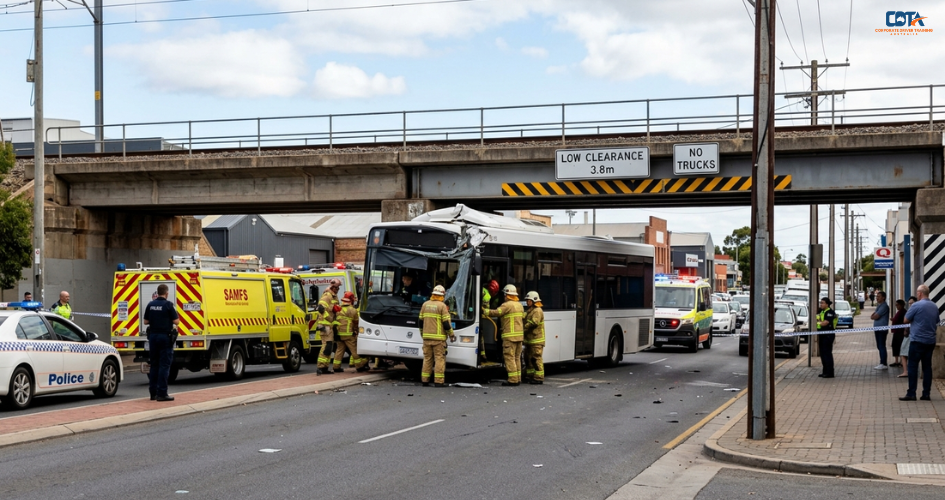
When operating large commercial vehicles—whether transport buses, delivery trucks, or specialist fleet vans—drivers face unique hazards that passenger car drivers rarely have to consider. One of the most critical, yet frequently overlooked, risks is overhead height clearance.
The recent incident in Port Adelaide, South Australia, where a passenger bus collided with a low-clearance railway bridge support on Commercial Road, serves as a stark reminder of what can happen when route assessment or spatial awareness fails. The impact left both the bus driver and a passenger temporarily trapped, caused significant disruptions to local vehicle traffic, and suspended passenger train services on the Outer Harbor line while emergency services conducted a delicate rescue operation.
While incidents like this are terrifying for those involved, they offer critical safety lessons for fleet managers, transport operators, and professional drivers across Australia. Preventing low-clearance collisions requires more than just reading a street sign—it demands a structured approach, comprehensive practical training through a Defensive Driving Course , situational awareness, and robust organizational fleet policies.
The Reality of Overhead Clearance Hazards in Australia
Across Australian metropolitan areas like Sydney, Melbourne, Brisbane, and Adelaide, urban infrastructure features a mix of historic bridges, low railway overpasses, underground carparks, and temporary overhead structures.
For professional drivers operating high-profile vehicles, overhead hazards present a constant risk. Collisions with bridges, awnings, or overhead cables are rarely caused by mechanical failure; in almost every instance, they stem from human factors such as:
-
Route Unfamiliarity: Taking detours or navigating unfamiliar suburban streets without pre-planning vehicle clearances.
-
Distraction and Fatigue: Missing critical road signs and overhead warnings due to cognitive overload or lack of focus.
-
Misjudging Vehicle Dimensions: Drivers switching between standard passenger vehicles and larger commercial transport without adjusting their spatial perception.
-
Over-Reliance on Standard GPS: Using consumer-grade navigation apps (such as standard Google Maps or Apple Maps) that calculate the fastest route for standard passenger cars, rather than heavy or commercial vehicle routes.
The financial and operational consequences of a bridge collision go far beyond vehicle damage. Companies face massive repair costs, inflated insurance premiums, third-party infrastructure liability, severe public transit delays, and significant reputation damage.
5 Critical Safety Lessons for Commercial Fleet Drivers
To prevent low-clearance impacts and maintain safe fleet operations, organizations must embed proactive habits into their daily driving routines. Here are five essential lessons derived from low-clearance incidents:
1. Know Your Vehicle’s Exact Operating Height
It is not enough to have a general idea of your vehicle's height. Drivers must know the exact total clearance height of the vehicle they are operating on that specific day.
-
Account for Loads and Attachments: Roof racks, air conditioning units, ladders, and temporary equipment increase your overall height.
-
Vehicle Swaps: Fleet drivers who frequently switch between smaller vans and larger trucks must perform a physical height check before turning the ignition.
-
In-Cab Height Decals: Every commercial vehicle should have a clear, high-visibility sticker on the dashboard displaying its exact total height in metres and feet.
2. Never Rely Solely on Standard GPS Navigation
Standard GPS mapping systems are designed for personal motor vehicles. They do not factor in bridge clearances, weight restrictions, or narrow turns. Heavy vehicles and large transport buses should use specialized GPS systems programmed with the vehicle’s specific dimensions.
3. Practice Active Observation and Hazard Perception
Low-risk driving relies on proactive visual scanning rather than reactive braking. Safe drivers maintain a 12-to-15 second visual lead time ahead of their vehicle. Drivers should scan overhead gantries, trees, bridge arches, and shop awnings regularly.
4. Understand Bridge Architecture and Road Camber
Clearance heights displayed on bridge signs are measured at specific points—often the lowest point or the centre of the arch. An arched bridge may meet clearance requirements in the centre lane but drop significantly over side lanes.
5. If in Doubt, Stop and Reassess
If a driver approaches a bridge or structure and feels uncertain about the clearance, the safest action is to stop before entering the hazard zone, activate hazard lights, and contact fleet dispatch.
The Role of Low Risk Driving & Defensive Driving Courses in Fleet Safety
At Corporate Driver Training Australia (CDTA), we believe that traditional skills alone are not enough to prevent high-risk workplace transport incidents. While a standard Defensive Driving Course teaches core vehicle handling techniques during emergency maneuvers, our advanced Low Risk Driving Course teaches drivers how to avoid getting into high-risk situations in the first place.
Through tailored corporate training programs, drivers develop critical reflective thinking styles, such as:
By shifting driver mindsets from passive operating to active hazard management, organizations significantly reduce crash rates, vehicle wear-and-tear, and operational downtime.
How Fleet Managers Can Protect Their Business
Fleet managers have a duty of care under Australian Work Health and Safety (WHS) laws to ensure safe systems of work for employees behind the wheel. To mitigate the risk of bridge crashes and overhead collisions, fleet managers should:
-
Implement Clear Cabin Signage: Ensure all fleet vehicles have accurate height indicators inside the cabin.
-
Audit Route Planning Tools: Supply drivers with heavy vehicle navigation tools suitable for their transport class.
-
Conduct Regular Fleet Safety Audits: Review past incidents and near-miss reports to identify recurring driver behaviors.
-
Invest in Professional Driver Development: Enroll corporate and fleet drivers in an accredited Defensive Driving Course and Low Risk Driving program.
Conclusion
The bridge collision in Port Adelaide is a sobering reminder that a single split-second oversight can result in severe injuries, major public infrastructure disruption, and costly property damage. Vehicle size awareness and proactive hazard perception are fundamental skills that every commercial driver must master.
Is your fleet protected against high-risk driving errors?
Book a Defensive Driving Course with Corporate Driver Training Australia today to equip your workforce with the skills needed to navigate Australian roads safely.
Frequently Asked Questions
Q1: What is the standard low-clearance bridge height warning in Australia?
In Australia, overhead clearance signs are regulated by state transport authorities. Structures with a clearance of less than 4.6 metres are typically marked with advance warning signs detailing the exact clearance height. Vehicles exceeding these heights must use designated heavy vehicle routes.
Q2: How does a Defensive Driving Course help prevent bridge crashes and fleet accidents?
A targeted Defensive Driving Course trains commercial drivers in hazard identification, spatial awareness, and proactive decision-making. It teaches drivers to scan ahead for clearance warnings, understand vehicle dynamics, and avoid high-risk situations before they turn into major accidents.
Q3: Why are standard GPS apps unsafe for commercial fleet vehicles?
Standard consumer GPS apps (like Google Maps or Apple Maps) select routes optimized for standard passenger cars. They do not contain data regarding bridge height limits, weight restrictions, or turning radiuses required for large commercial vans, trucks, and buses.
Q4: How does CDTA's Low Risk Driving approach complement a traditional Defensive Driving Course?
While a traditional Defensive Driving Course focuses on car control and emergency braking maneuvers, CDTA’s Low Risk Driving approach focuses on behavioral change, cognitive perception, hazard identification, and risk avoidance—ensuring drivers never put themselves in critical situations to begin with.
Q5: Can low-clearance collisions affect a business under Australian WHS laws?
Yes. Work vehicles are legally considered workplaces under Australian Work Health and Safety (WHS) legislation. Employers are required to provide adequate training, safe equipment, and risk management procedures to protect their drivers and the public from preventable road incidents.