What’s the Article About?
This article explains essential load security laws in Australia and how corporate drivers can stay compliant while towing, with insights on safety practices and the role of a trailer towing course in reducing risks.
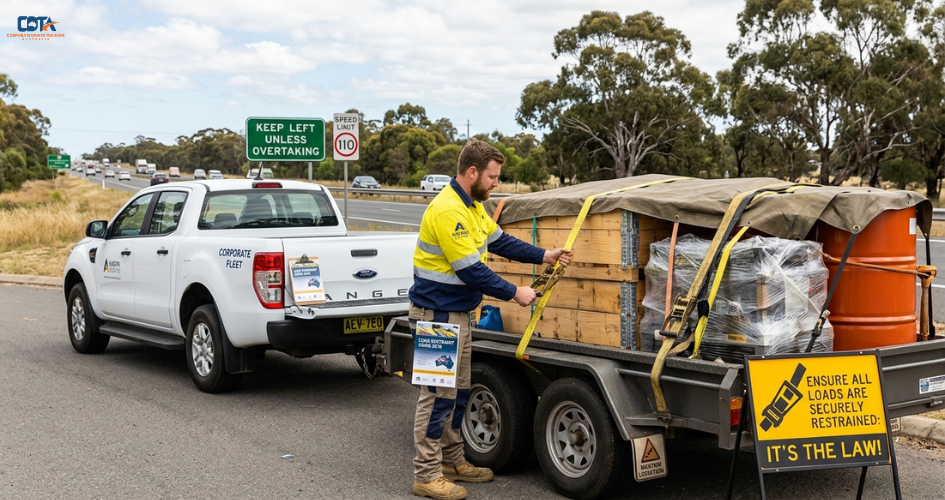
In Australia, trailer towing’s load security isn’t just a good practice but a prominent law. Especially for corporate drivers handling trailers, heavy equipment, or caravans, even a slight mistake can cost penalties, serious safety risks, and operational delays. So, if you are handling a business that is dependent on availing such services, understanding the trailer-towing laws is of the utmost importance. And, beyond that, to facilitate your drivers with the best of it all, CDTA’s trailer towing course is non-negotiable.
But Why Does Load Security Matter More Than You Think
It is because an unsecured or poorly secured load can shift during braking or turning, or fall off and cause accidents. At times, it can even damage the company’s important assets. All this can collectively lead to heavy fines and legal trouble. Therefore, in Australia, authorities have strictly laid out and enforced the load rules and regulations under the National Load Restraint Guide. This applies to all the vehicles, including corporate fleets.
Important Load Security Laws In Australia
While there are many of the laws that one needs to follow, below is the simplified breakdown of what every driver needs to follow:
1. Your Load Must Be Fully Secured At All Times
Loads must be controlled well so they don’t shift, fall, or dislodge during transit. Unsecured or uncovered loads can lead to fines and serious safety risks for both the driver and other vehicles on the road. In simple terms, if the load is able to move, it’s not secured.
2. Stay Within Legal Weight & Towing Limits
The trailer’s weight must not exceed the vehicle's towing capacity, the trailer’s capacity, and the towbar and coupling rating, in which the common ratings range from 750kg (unbraked) to 3500kg+ (braked) for heavy-duty, while 50mm couplings often contribute to a D-value rating. Overloading is illegal and dangerous. This is where most corporate fleets slip—guesswork instead of actual weight checks.
3. Follow Proper Load Distribution Rules
As per the rulebook, around 60% of the load should sit forward of the axle. It is suggested to keep loads low, centred, and balanced and maintain correct tow ball weight by typically 5–10%. This means that poor distribution of the load can lead to trailer swaying and result in the ultimate loss of control.
4. Respect Size & Overhang Limits
Loads must never extend beyond legal width limits. If such a thing is to happen, a rear overhang beyond 1.2m will require a visible red flag. At night, a red light or reflector is mandatory. In all, clear visibility means safety and adherence to compliance.
5. Safety Chains & Couplings Are Mandatory
Trailers must mandatorily have at least one safety chain (under 2500 kg) or two chains (over 2500 kg). In that, chains must be correctly attached and crossed if dual. This is because, in case your trailer detaches, these are your last line of defence.
6. Your Equipment Must Be Roadworthy
Before every trip, it is on the driver's shoulders that they must check tyres: their inflation & condition; brakes and suspension; lights and indicators; and couplings and connections. A faulty setup is already non-compliant, even if your load is perfect. So, it’s always better to doubt and check everything before taking the road.
7. Ongoing Checks During Transit Are Required
Drivers must regularly take a stop and inspect load restraints, couplings, and tyres. Compliance doesn’t stop when the trip starts, but it continues throughout to be safe and clear.
Therefore, even though the rules sound direct, they still require practical skill to execute correctly. That’s why many companies now rely on trailer towing courses to turn legal knowledge into real-world driving ethics.
How CDTA’s Trailer Towing Course Can Help In Better Driving
A professional trailer towing course goes beyond basic driving skills. It focuses on the aspects that a driver needs when they are on the road, driving. Some of the points need to be said out loud for you to understand why CDTA’s course matters.
-
Correct Load Restraint Techniques: Through the lessons, your drivers will learn how to choose the right restraints, apply correct tension, and secure different load types to transfer the vehicle from its source to its destination.
-
Legal Compliance Training: The towing course ensures that drivers understand the Australian towing laws, load restraint standards, and penalties for non-compliance. This means theory with practical knowledge.
-
Real-World Scenarios: Drivers practise emergency braking with loads, handling load shifts, and driving in adverse conditions. This is especially useful in a caravan towing course, where wind drag and long-distance towing are factors.
You’ll See The Difference By Yourself: Before vs After Training Impact.
|
FACTOR
|
BEFORE TRAINING
|
AFTER TRAINING
|
|
Load Safety
|
Drivers are uninformed and inconsistent
|
Post-lessons, drivers are reliable and trusted more
|
|
Compliance
|
Everything seems to be risky before
|
Practices go on a fully compliant scale
|
|
Driver Confidence
|
It is low before initial training
|
The trailer towing course definitely boosts confidence
|
|
Accident Risk
|
Very high risk
|
Not completely over, but the risk factor is reduced
|
|
Operational Efficiency
|
Quite unstable due to inexperience
|
The efficiency is very well optimized
|
Final Thoughts: Why Businesses Must Take Trailer Towing Seriously
Well, nothing ends well when it is ignored for long. In our case, we are talking about the company and drivers, which impact a lot of things. Security laws don’t just risk fines; they affect your entire operation, like insurance claims can be denied, brand reputation can suffer, projects can face delays, and, foremost, employee safety is compromised. Investing in CDTA’s law-compliant towing course is far cheaper than dealing with the consequences of a single incident.
So, here’s a smart move that you can make at this hour. Combine compliance knowledge with hands-on training through the caravan towing course. Because when your load is secure, your business is secure too.
FAQs
1. What are the basic load security laws for towing in Australia?
Drivers must ensure the load is properly restrained, evenly distributed, within legal weight limits, and does not move, fall, or create hazards during transit.
2. What happens if a load is not secured properly?
Unsecured loads can lead to fines, penalties, insurance issues, and serious road accidents, making compliance critical for corporate drivers.
3. How can a trailer towing course help with load security?
A trailer towing course provides hands-on training in load restraint techniques, weight distribution, and legal compliance, reducing risks significantly.
4. Is load distribution really that important while towing?
Yes, improper distribution can cause trailer sway, loss of control, and increased braking distance, making it one of the most important safety factors.
5. How often should load checks be done during a trip?
Drivers should inspect the load before starting and periodically during the journey, especially after long distances or rough road conditions.