What This Article Covers
Learn how to identify and avoid the most common towing mistakes, improve towing safety, protect your vehicle and trailer, and build greater confidence when towing on Australian roads.
What Many Drivers Get Wrong About Towing
Whether it’s hauling boats and caravans for trips or using trailers for work purposes, towing has always been a part of the Australian lifestyle. Due to its load-bearing capacity, towing a trailer or caravan provides greater flexibility and easy transport. However, towing also places additional demands on both the driver and the vehicle. Small driving mistakes that wouldn’t have mattered in a small vehicle can significantly affect steering, braking, stability, and overall safety in trailer towing. As the demand for trailers increases in the corporate setup, the need for proper towing knowledge through professional trailer towing courses is also increasing. Whether you tow regularly or are preparing for your first trip, understanding the most common towing mistakes can help you avoid costly repairs, stressful situations, and potentially dangerous incidents. In this blog, we’ll explore the most common yet significant towing mistakes and how drivers can avoid them.
1. Choosing the Wrong Tow Vehicle
Do you assume that any vehicle that has a tow bar is automatically suitable for towing? That’s where many drivers go wrong. A vehicle’s towing capability involves much more than a maximum tow rating. You must also consider things like payload, Gross Vehicle Mass (GVM), Gross Combination Mass (GCM), braking performance, suspension, and how the vehicle handles under load. If you don’t choose a vehicle that matches your requirements in these factors, you’ll face many challenges.
You must ensure your towing setup meets the legal requirements of the weight you want to carry, especially when you’re thinking of towing larger caravans that may require electric brakes. Before purchasing a caravan or trailer, take the time to understand what your vehicle can safely and legally tow. And a professional trailer towing course is a good way to familiarise yourself with your vehicle and understand its limitations and towing requirements.
2. Exceeding Weight Limits
Many drivers aren’t aware of how much weight their tow trucks can carry. That’s why most towing problems are about excessive weight. There are set legal limits to how much weight a truck should ideally carry, and it varies from one vehicle to another. In every tow truck, there are many factors associated with the vehicle weight, like its towing capacity, Gross Combined Weight Rating (GCWR), or Gross Vehicle Weight Rating (GVWR). So, if you exceed your vehicle’s capacity in these factors, you might face a dramatic increase in stopping distances and a decrease in vehicle control.
The best way to avoid this is to check the manufacturer's specifications and weigh your fully loaded vehicle and trailer if necessary. You can use public weighbridges to get accurate information and the necessary help ensuring your setup remains within legal limits
3. Incorrect Weight Distribution
While how much you can load is an important point, the way you load your trailer also matters a lot. If you don’t distribute the weight across the trailer properly, it will have balance issues. Having too much weight concentrated on one side can cause the trailer to sway. If you place too much weight at the back, the centre of gravity is shifted backwards, making the trailer unstable at higher speeds. Similarly, not placing enough weight on the tow ball can also make the trailer unstable.
To avoid this, ensure your tow ball weight is around 10% to 15% of your total trailer weight. Load heavy items on the low and position them close to or slightly ahead of the trailer’s axle group. You can learn how to properly distribute weight in the trailer through a professional-quality caravan towing course.
4. Ignoring Tyre Pressures
The safety of your tow depends a lot on your vehicle’s tyres. If your tyres are underinflated, they will create extra rolling resistance, generate excess heat, and increase the risk of tyre failure. And when you’re towing, you’re carrying an added load, which makes these risks even more serious. To avoid getting stuck with underinflated tyres, you should check the tyre pressures on both the tow vehicle and the trailer before every trip. Also, make sure you always follow the towing pressures that the manufacturers recommend instead of using the standard, day-to-day settings.
5. Driving Too Fast for Conditions
When you use a vehicle for towing, it behaves a bit differently from its normal use. When you add a loaded trailer to your vehicle, it increases stopping distances, reduces acceleration, and makes your vehicle more susceptible to crosswinds and sudden steering inputs. And if you travel too fast with a loaded vehicle, your hazard reaction time decreases and the chances of your trailer swaying increase. To avoid this, you should always keep a safe following distance and travel at speeds that are appropriate for the road and surroundings.
6. Skipping Pre-Trip Safety Checks
Most drivers forget to do a pre-trip safety check or consider it unimportant, which can be very risky. Even if you don’t have much time, take out a few minutes to check your setup. Do a complete walk-around inspection of your vehicle before every trip. Also, check hitch connections, safety chains, electrical plugs, breakaway systems, trailer lights, tyres, and load security. When you have a habit of checking the safety measures of your vehicle before every trip, you can find out even the smallest of issues early on and prevent them from escalating further.
7. Incorrectly Hitching or Securing the Trailer
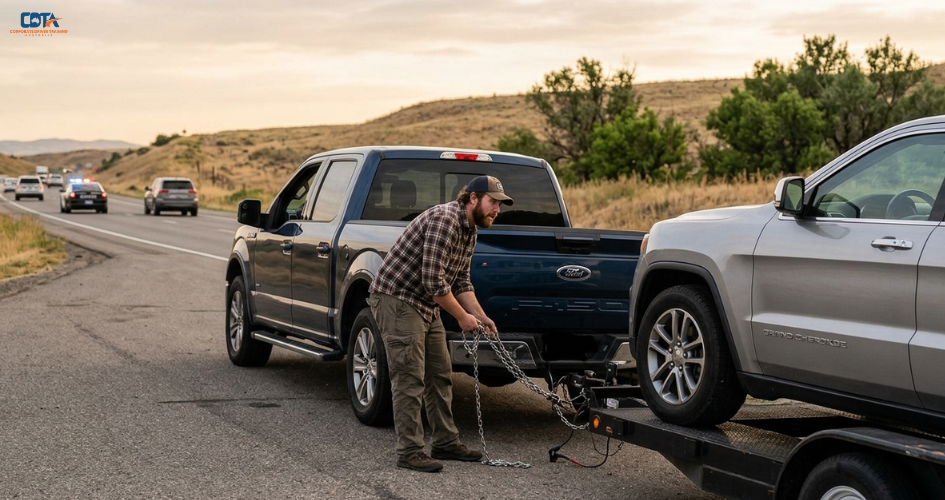
Even with the correct vehicle and trailer, poor hitching practices can create serious risks. Incorrectly attached chains, straps, hooks, or couplings can allow a trailer to shift, become unstable, or even detach while travelling. These mistakes are particularly common among inexperienced operators and those towing unfamiliar trailers. To avoid this, you should always ensure chains, hooks, and straps are attached to designated points and that all connections are properly secured before departure. Take a final walk around the vehicle and trailer to check for loose fittings, slack chains, or anything that appears out of place.
Build Safer Towing Habits
Most towing incidents are preventable. Understanding vehicle limits, loading correctly, conducting safety checks, and driving appropriately for conditions can make a significant difference to safety and confidence on the road. If you want to strengthen your skills and gain practical experience, a professional towing course can help you better understand trailer control, weight management, reversing techniques, and safe towing practices.
At Corporate Driver Training Australia, we have trained professionals teaching trailer towing courses and caravan towing courses designed to help drivers tow with greater confidence, competence, and safety. Join us today and learn to tow like a pro!
Frequently Asked Questions
Q1. What is the most common towing mistake?
A: One of the most common towing mistakes is exceeding the vehicle's towing capacity or loading the trailer incorrectly, which can affect stability, braking, and vehicle control.
Q2. Why is weight distribution important when towing?
A: Proper weight distribution helps maintain trailer stability and reduces the risk of trailer sway, especially at higher speeds.
Q3. How often should I check tyre pressures when towing?
A: Tyre pressures should be checked before every towing trip on both the tow vehicle and the trailer.
Q4. Can a trailer towing course help improve towing safety?
A: Yes. A trailer towing course provides practical training on vehicle control, trailer handling, reversing, weight management, and safe towing practices.
Q5. What should be included in a pre-trip towing inspection?
A: A pre-trip inspection should include checking the hitch, safety chains, electrical connections, trailer lights, tyres, load security, and any braking systems.
Q6. Is a caravan towing course suitable for beginners?
A: Absolutely. A caravan towing course is valuable for both new and experienced drivers, helping them build confidence and develop safer towing habits.