What’s the Article Talking About? Know how driver safety audits in Australia help businesses reduce risks, improve compliance, and enhance driver behaviour through regular assessments, training, and defensive driving practices.
If you are a fleet-operating business, or even if not, driver safety has always been a critical part of workplace safety. If you are a businessperson whose business has enlisted a driver workforce for their employees’ commutation, work-related driving is one of the high-risk activities across industries. Therefore, it is also a rule and a mandatory thing in such workplaces to carry out regular audits for safety and compliance.
A systematic audit process not only helps companies identify risks but also improves driver techniques and ensures that the work being done is done in accordance with rules and regulations. Whether or not incorporating a low-risk driving course will play a key role in creating a safe driver environment. But, before that, let’s explore some of the best practices that organisations follow in Australia.
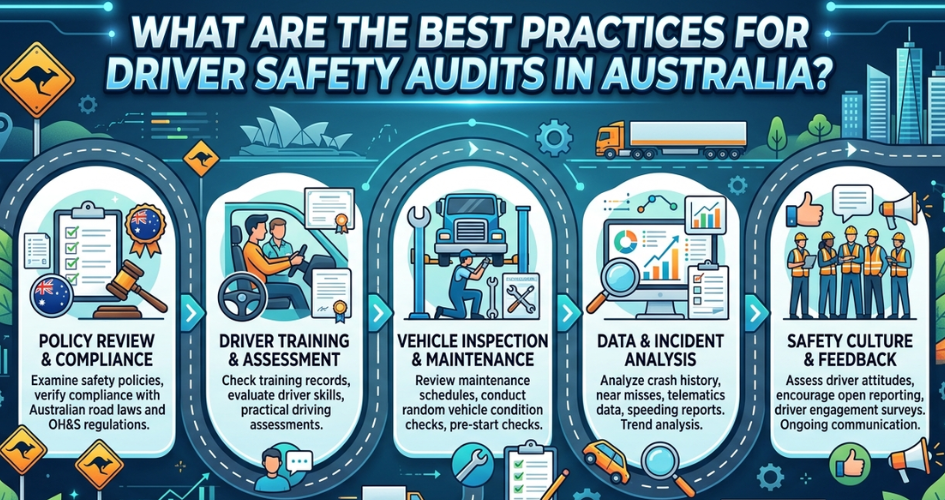
Always Begin With A Clear Safety Policy
A well-planned audit begins with a structured and proper driver safety policy. This policy should define expectations, responsibilities, and procedures related to driving at work for the drivers. It needs to be necessarily aligned with the Australian road laws and workplace safety commitments. It should also state the various factors, including speed limits, alcohol restrictions, and seatbelt use. A strong policy must also set the foundation for low-risk driving courses for corporate drivers.
Conduct Regular Driver Assessments
Individual driver performance needs to be monitored frequently. And this practice is one of the most important auditing practices in modern safety programmes. Analysing driver behaviour, driving patterns, past incidents (accidental or non-accidental), and risk exposure is a must. Apart from this, reviewing their records, assessing their perception skills, and improving things based on it come under the driving safety courses.
Focus On Defensive Driving Training
How well can your driver anticipate hazards? Or how well he can maintain safe distances, stay alert on the road, or make decisions that are both swift and safe matters the most. This is what a defensive driving course does. A best practice in driver safety audits is evaluating a driver on the above-mentioned measures. In Australia, many companies have already switched to CDTA’s driving course. Why? Because they know that the human factors like attention, mindset, and decision-making are their top priority.
Use Data and Technology for Monitoring
Today, driver safety audits depend on data. Fleet management systems and telematics tools are able to track speeding behaviour, harsh braking or acceleration, route patterns, and driver fatigue indicators. Data-driven audits are always the best and help the organisations derive the results and move from reactive to proactive decision-making. All this makes up a combined lesson during the driver safety training.
Audit Vehicle Safety And Maintenance
The driver’s driving habits aren’t the ones to be safe about, but at times, it’s the vehicle that hasn’t been properly checked. A complete audit should include regular vehicle inspections, brake and tyre checks, safety equipment verification, and agreement with the Australian vehicle standards. Ensuring that a vehicle is roadworthy itself reduces the chances of accidents. It also plays an important part in driver safety training, as both the driver and the vehicle must be safe at the end of the day.
Ensure Compliance with WHS Obligations
In the Australian subcontinent, each employer has a legal duty under Work Health and Safety (WHS) laws to provide a safe and sound working environment for their respective employees. This also includes managing risks related to driving for work. The driver safety audit should document risks and controls, ensure training completion, maintain legal records, and demonstrate a fair duty of care. Organisations that adhere to these compliances and low-risk driving courses are less likely to be called out for penalty filings.
Promoting a Safety-First Culture
Audits are the most effective when they are promoted by a strong safety culture. This means encouraging drivers to prioritise safety over speed or convenience. This includes regular safety briefings, incentives for safe driving, open reporting of incidents, and continuous learning through defensive driving lessons. When safety becomes part of the work culture, the outcomes are as glorious as they can be.
Concluding Words
Driver safety audits are necessary for organisations operating in Australia, especially the corporate fleets or employees who depend on a drive to work. By combining regular audits with low-risk driving courses and defensive driving lessons, businesses can significantly reduce risks and improve overall safety outcomes.
Because ultimately investing in proper audits and training programmes won’t just help the drivers, but will also take care of compliance, protect public life, and build a responsible driving culture across the organisations.
FAQs
1. What is a driver safety audit?
A driver safety audit is an evaluation of driver behaviour, vehicle condition, and safety practices to identify and tame risks.
2. Why are low-risk driving courses important for businesses?
Low-risk driving courses help corporate drivers improve road awareness, reduce accidents, and meet workplace safety standards.
3. What does a driving safety course include?
A driving safety course typically covers road rules, defensive driving techniques, and risk management strategies.
4. How often should driver safety audits be conducted?
Driver safety audits should be conducted regularly, usually annually or more frequently for high-risk operations.
5. What is the benefit of defensive driving lessons?
Defensive driving lessons help drivers anticipate hazards and make safer decisions, reducing the likelihood of accidents.