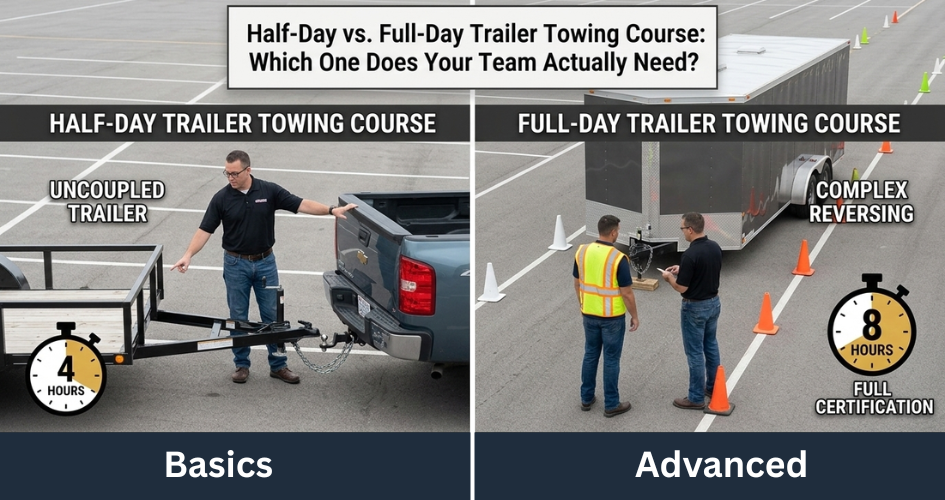
What’s Discussed in the Article? Choosing between a half-day and full-day trailer towing course depends on how often your team tows and their level of experience. While half-day training covers the essentials, a full-day towing course provides extensive learning and practicals for more complex towing tasks.
It isn’t that easy to tow a trailer. Why? Are you equipped with the skills of managing extra weights or handling turns like a pro, or can you confidently reverse, brake, and juggle through the situations that require that specific experience? Well, worry not, as Corporate Driver Training Australia’s trailer towing course is all about that. Individuals and businesses dealing with the subject enrol in the programme only to find the best practices happening across the travel industry.
Designed to help drivers understand every minute detail regarding towing dynamics, safety practices, and manoeuvring techniques, the course is divided into two parts: the Half-Day Trailer Towing Course and the Full-Day Course. While both offer valuable learnings, it is up to the specific requirement to enrol in one that is suitable for the needs. To understand things quickly, let’s see what each course has in store for you.
For Fast-Track Learning: Half-Day Trailer Towing Course
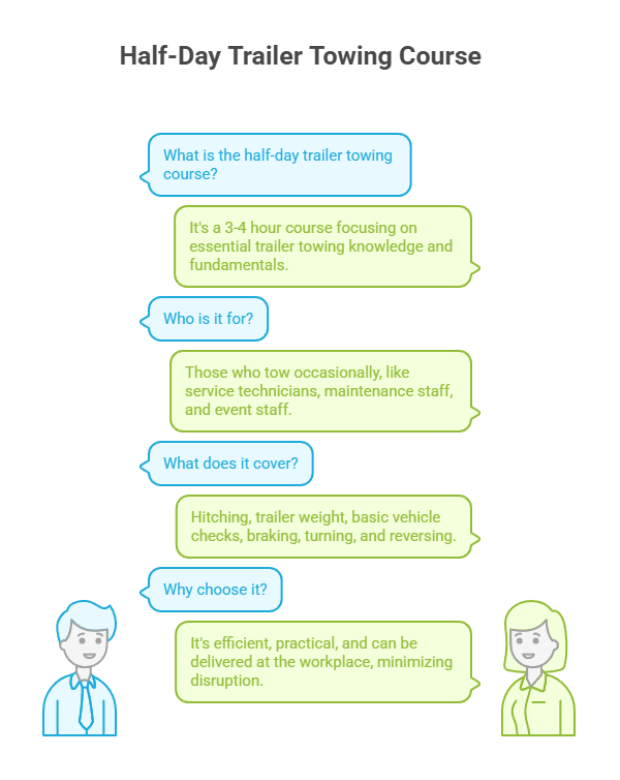
You might get it by the name that it is a half-day course. This one is designed to provide essential knowledge and focuses on imparting the fundamentals that any trailer driver must be acquainted with. The timeframe of such a course is between three and four hours, normally 3.5 hours in total. This type of towing course is usually taken by those who tow occasionally, for example, service technicians, maintenance staff, event hosting staff, etc.
The core modules that are covered in the half-day trailer-towing course are the following:
-
Hitching and unhitching techniques
-
Trailer weight considerations
-
Basic vehicle checks
-
Safe braking and turning
-
An introduction to reversing with a trailer
Although basic, this course is designed in a way that covers the risk of mistakes and safety that lead to accidents or equipment damage in some cases. Known for its efficiency, a half-day course is usually delivered at the workplace of a company itself; that’s how convenient CDTA’s services are. This results in a practical choice for the firms or organisations that do not want to disrupt the operation while providing such a course to their employees.
For Comprehensive Skill Development: Full-Day Trailer Towing Course
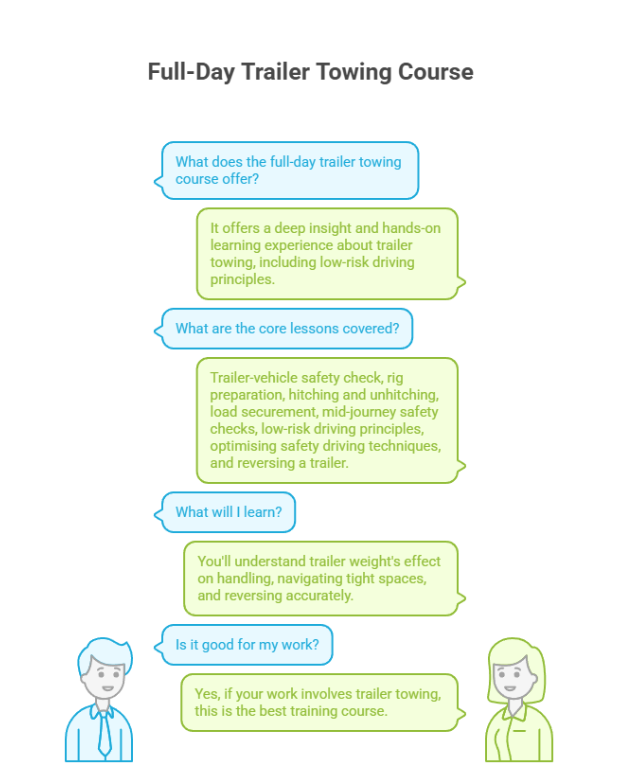
As opposed to the half-day course, the full-day course offers a deep insight and a hands-on learning experience about the trailer towing course. Designed to last for almost eight hours, CDTA’s full-day trailer towing course also incorporates a few aspects of the low-risk driving course. The full-time format allows the participants to fully understand the techniques and challenges that come with trailer towing and driving.
The core lessons that are covered in the full-day trailer-towing course are the following:
-
Trailer-vehicle safety check
-
Rig preparation
-
Hitching and unhitching
-
Load securement and weight distribution
-
Mid-journey safety checks
-
Low-risk driving principles
-
Optimising safety driving techniques
-
Reversing a trailer
Through this course, the drivers are able to understand how trailer weight affects vehicle handling, how to navigate and scour tight spaces, and how to reverse accurately without getting hurdles in the way. Apart from several different types that it has, caravan towing is one such area wherein trailer towing has the most momentum. It involves additional guidance on managing long trailers, preventing sway, and maintaining control at highway speeds.
So, for a person whose work aligns with the scope of trailer towing itself, this one’s the best training course to look out for and work accordingly.
Key Differences: Half-Day vs. Full-Day Towing Course
Below is a difference between the two towing courses that we discussed before in a simpler, tabular format:
|
BASIS OF DIFFERENCE
|
HALF-DAY TRAILER TOWING COURSE
|
FULL-DAY TRAILER TOWING COURSE
|
|
Duration
|
Between 3 and 4 hours
|
Completes between 6 and 8 hours
|
|
Training Depth
|
Basic and introductory
|
Detailed and comprehensive
|
|
Practical Practice
|
Majorly theoretical; limited hands-on training
|
Extensive hands-on experience
|
|
Skills Covered
|
Basic hitching, safety checks, simple movements
|
Advanced reversing, load control, tight operations
|
|
Ideal Participants
|
Experienced drivers needing quick training
|
New drivers or teams handling heavy trailers
|
|
Best For
|
Occasional towing or refresher training
|
Frequent towing or beginners
|
With this difference, you will be able to give a judgement about the best way of trailer towing and what one should opt for.
Final Thoughts: Which Course Should You Opt For
While it ultimately depends upon the towing capabilities of your team, we have stated a stark difference between the two trailer towing course that will help you in finding the best one for your team. If your team occasionally performs the towing tasks, a half-day course will be perfect for you. Or, if your team is active enough to work every day, a full-day course or a caravan towing course is the option that you must opt for.
At the end of the day, the right training is the one that will make you ready for your next adventures. To know more about the courses, CDTA’s handbook of knowledge is the one that’s going to impart the best of it.
FAQs
Q1: Who should choose the Half-Day Trailer Towing Familiarisation Course?
The half-day course is ideal for employees who occasionally tow small to medium-sized trailers — including tandem trailers — as part of their job. It runs for approximately 3.5 hours and covers pre-towing preparation, driving techniques, and reversing. It suits businesses that need to train multiple teams in a single day, as two sessions can be delivered on-site within one working day.
Q2: Who needs the Full-Day Low Risk Trailer Towing Course?
The full-day course is designed for drivers who regularly tow trailers — including larger, heavier trailers — as a core part of their role. It combines advanced low-risk driving principles with complex towing scenarios such as emergency handling, managing large trailer movements, and precise reversing. If your team works in construction, utilities, or events, this is the right choice.
Q3: Can the trailer towing course be delivered at our workplace?
Yes. Both the half-day and full-day trailer towing courses are conducted on-site at your workplace. Participants use their own company vehicles and trailers, so the skills learned are directly applicable to your team's real work environment.
Q4: Do participants receive a certificate after completing the course?
Yes. A Certificate of Completion is issued to every participant upon finishing either the half-day or full-day trailer towing course.
Q5: Is a trailer towing course a legal requirement for employees in Australia?
While a specific towing licence is not always required, Australian Work Health and Safety (WHS) laws place a duty of care on employers to ensure staff are competent to perform work tasks safely. Enrolling your team in a trailer towing course is a practical and documented way to meet that obligation and reduce fleet risk.
Q6: How do I book a trailer towing course for my team?
You can contact Corporate Driver Training Australia directly on 1800 757 615 or email info@cdta.com.au to arrange a private group booking tailored to your team's schedule and location.